Tag: Bibel
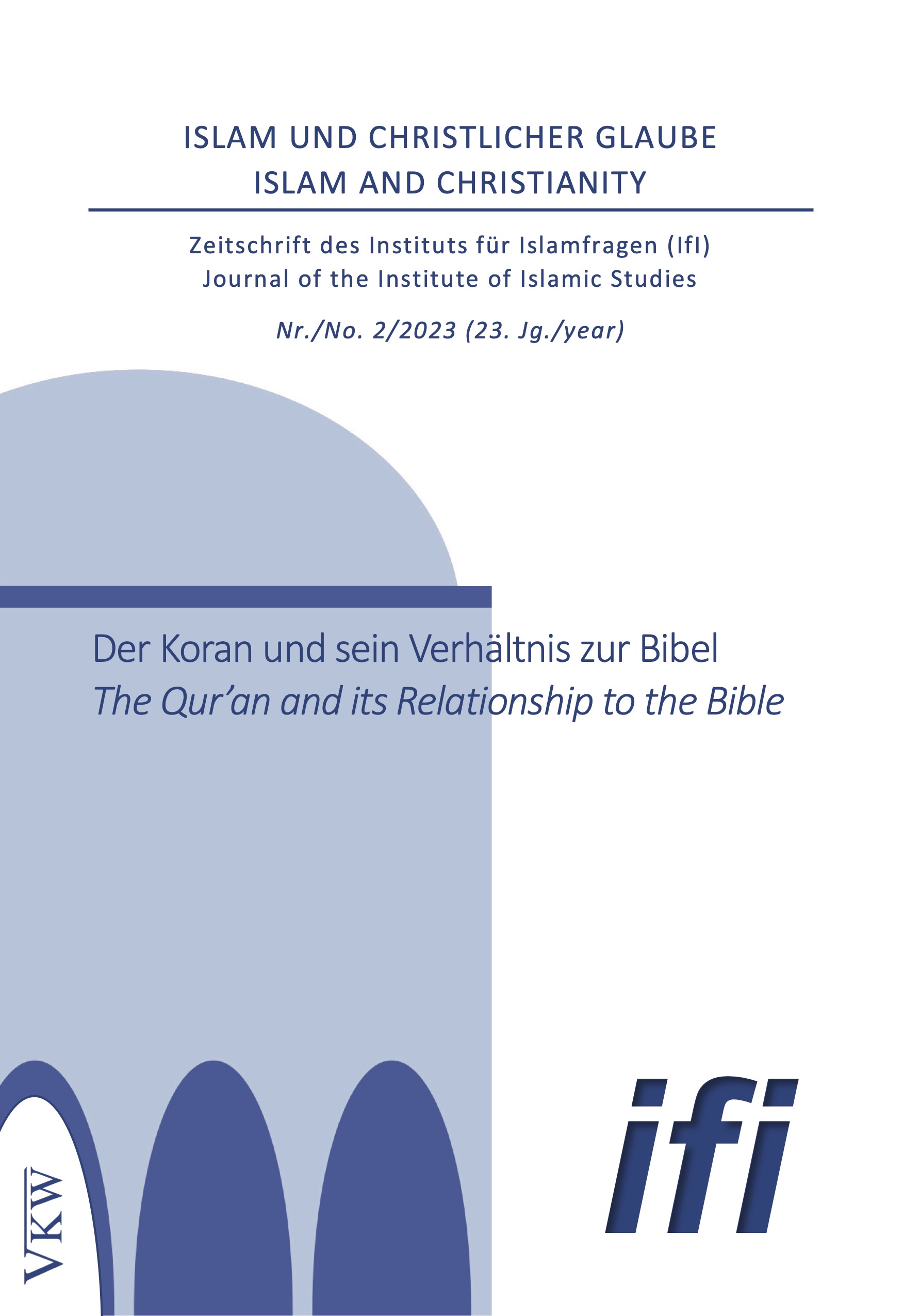
Islam and Christianity • No. 2/2023 (23. Jg.)
The Qur’an and its Relationship to the Bible

Islam and Christianity Nr. 1/2019 (19. Jg.)
Biblical and Qurʾānic Passages of Violence in Context
(Deutsch) Rezension: Christen und Muslime: So nah, und doch so fremd
(Deutsch) Frische bewegten beim Schreiben des Buches die Fragen: Wie werden sich in Zukunft die Staaten Europas und Nordamerikas und die sie mitverantwortenden Christen zum Islam verhalten? Wo haben wir Platz zu machen – räumlich, damit Menschen eine Unterkunft finden, in der Arbeitswelt, damit Menschen in Arbeit und Brot kommen, dann auch jeder Einzelne in seinem täglichen Leben, in seinem Herzen und in seinem Kopf? Drängende Fragen, denen Hartmut Frische engagiert, umsichtig und mit offenem Herzen nachgeht.
(Deutsch) Fatwa zu der Frage, ob Horrorfilme angesehen werden dürfen
(Deutsch) (Institut für Islamfragen, dh, 02.12.2014) Frage: „Wie wird es [islamisch] beurteilt, wenn Horrorfilme angesehen werden, in denen Besessenheit von Teufeln und Dämonen und die Austreibung von Dämonen mit dem Kreuz und der Bibel, etc. dargestellt werden?“
Islam and Christianity Nr 1/2014 (14. Jg.)
God and Man in Bible and Quran
Islam and Christianity Nr. 1/2011 (11. Jg.)
Quran and Its Relationship to the Biblical Texts
“Divine Grace” in the Bible and in the Qur’an
The biblical concept of “grace” has many meanings which are hardly understood any longer outside of the Church. The term has been divested of its senses in modern English, and its modernday usage does not cover the multifaceted meanings of the biblical term. However, grace is a fundamental biblical concept which distinguishes the Christian faith from all other religions.Is the Qur’an and Islam familiar with the concept God’s “grace” at all? What are the similarities and differences between the Bible and the Qur’an? What points of contact can be used to convey the biblical message to Muslims?
“Love” in the Bible and the Qur’an
(Deutsch) Zum Vergleich des in Bibel und Koran vermittelten Gottesbildes ist das Attribut der „Liebe” Gottes, das in der Bibel von zentraler Bedeutung ist, ein guter Ansatzpunkt.
IfI Press Release on the Christmas Holiday
Bonn (December 21, 2009) In discussions about social integration and interreligious life together, the call for the harmonization of Christian and Islamic faith conceptions is not a rare occurrence. This call fails, in the view of Eberhard Troeger from the Institute of Islamic Studies, above all because of the divergent statements in the Bible and the Koran about Jesus’ identity and message.
Who is God in the Koran?
The Koran does not contain any passages which comprise any kind of systematic description of the characteristics of God. In Arabic he is called “Allah”, which means simply “The God”. God does not introduce himself in the Koran like he does in the Old Testament, with the words “I am who I am”, (Exodus 3,14, NASB) but remains hidden – a mystery.
(Deutsch) Gott in der Bibel – Allah im Koran
(Deutsch) Heutzutage glauben viele Menschen, dass alle Religionen bzw. Götter in gewisser Weise gleich seien. Alle oder doch wenigstens die monotheistischen Religionen sollen versuchen, Brücken zwischen Menschen und den wohlwollenden Kräften innerhalb dieser Religionen zu schlagen. Alle Götter seien hohe Wesen, auf die der Mensch angewiesen sei. Alle Religionen, so glaubt man, geben dem Menschen Anweisung, eine bestimmte Haltung gegenüber den höchsten Kräften einzunehmen. Alle Religionen fordern den Glauben an übernatürliche Kräfte und Wesen (Engel, Teufel, Geister usw.), sie streben eine qualitative Verwandlung des Menschen an u.ä.m.
(Deutsch) Kairoer Kritiker ruft Muslime zur Reform nach protestantischem Vorbild auf
(Deutsch) (Institut für Islamfragen, mk, 20.10.2006) Wie wichtig sind die Hadith-Sammlungen neben dem Koran?
(Deutsch) Rechtsradikale in der Türkei aggressiv gegen christlichen Verlag
(Deutsch) (Institut für Islamfragen, mk, 05.04.2006) Islamisten wollen Bibel verbieten
(Deutsch) Größte ägyptische Filmproduktion aller Zeiten als Reaktion auf den Karikaturenstreit in Planung
(Deutsch) (Institut für Islamfragen, dh, 17.03.2006) Es soll ein Film über das Leben und Leiden Jesu Christi werden
(Deutsch) Saudischer Lehrer wegen Blasphemie zu 3,5 Jahre Haft und 750 Peitschenhieben verurteilt
(Deutsch) (Institut für Islamfragen, dh, 28.11.2005) Auspeitschung findet in der Öffentlichkeit statt
(Deutsch) Indischer Katholik in Saudi-Arabien inhaftiert
(Deutsch) (Institut für Islamfragen, 23.09.2004, mm) Wie der österreichische katholische Nachrichtendienst kath.net am 18. d.M. berichtete, wurde der indische Katholik Brian Savio O’Connor wegen des Besitzes von Bibeln in Saudi-Arabien verhaftet. Er wurde am 15. September vor ein Gericht gestellt. Der Prozeß soll insgesamt 90 Minuten gedauert haben.